
Lessons from Automating Protein Design for AI Algorithm Discovery
In biology, we learned how to accelerate protein design using AI models. In AI itself, we are now learning to accelerate the discovery of new, better algorithms. Although the fields are different, underneath they share one shape: search a vast combinatorial space for a design that optimizes an objective [1]. Since automated protein design is far ahead of automated AI algorithm design, it is worth asking what we can learn from its progress to help us move faster in automating AI algorithm discovery.
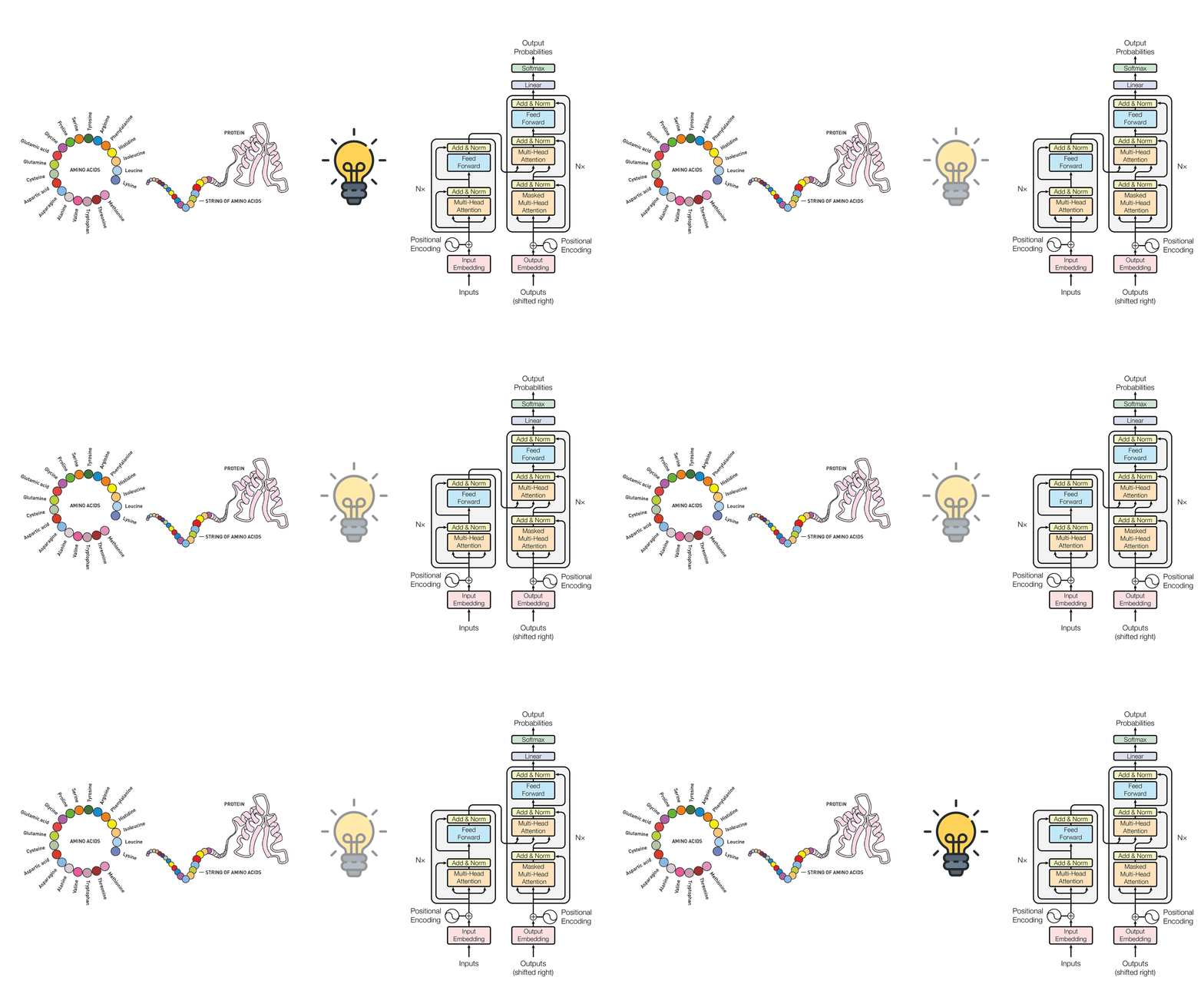
Automating protein design
Protein design became tractable with breakthrough ideas in three key components, recognized with three Nobel Prizes.
- Representation: While a protein is known as a complex 3D structure in nature, it was shown in 1951 that each protein can be represented by a unique sequence of amino acids (Nobel Prize, 1958) [2], where there are 20 basic amino acids. It is like a new language for proteins with only 20 letters. Everything downstream depends on this representation.
- Objective function evaluation: A way to predict the objective from a sequence without running a wet-lab experiment. The objective is largely determined by the protein's 3D structure, so the hard part was predicting that structure from the sequence — cracked by AlphaFold2 in 2021 (Nobel Prize, 2024), with accuracy comparable to experiments in most cases [3].
- Search: Given a target function, find a sequence that delivers it. Traditionally, laboratory evolutionary methods — directed evolution, which iterates mutation and selection over sequence space — were used to search for high-performing proteins (Nobel Prize, 2018) [4]. More recently, generative models learn the distribution of known proteins and their functions, and new proteins are sampled from it.
The payoff is not hypothetical. When the SARS-CoV-2 sequence was published on 11 January 2020, the antigen for Moderna's vaccine — a prefusion-stabilized spike protein — was finalized within days, because the design and the objective function evaluation were already computational [5].
Automating AI algorithm discovery
Automated AI algorithm discovery is walking the same three-step path, but it is still at an early stage.
- Representation is the open question. An algorithm can be encoded as a set of hyperparameters, a computation graph, or code. The choice bounds everything that follows, exactly as the amino-acid representation did for proteins.
- Objective function evaluation for AI algorithms is usually easily quantifiable, though it can become computationally expensive in some cases.
- Search has had three main upgrades, each widening the space being searched: (i) hyperparameter tuning, which explores different parameter settings within a fixed algorithmic framework; (ii) hyper-heuristics, a step further, which were introduced to design new heuristics by combining the components of known heuristics, originally for scheduling problems [6][7]; (iii) more flexible search spaces opened up by LLMs, where the search ranges over code itself, so that new algorithmic structures — not just tuned or recombined heuristics — can be discovered [8][9].
Concluding words
The takeaway for anyone building an algorithm-discovery system is compact:
- The representation is the game changer. Protein design did not advance until the sequence representation was settled. Algorithm discovery is still unsettled here — hyperparameters, graphs, and code impose very different ceilings on what can be found.
- Make the objective function evaluators as efficient as possible. AlphaFold's deepest contribution was making an expensive evaluation cheap, which made it possible to search a much larger space of solutions.
- As long as no simple representation exists, sampling from a generative model remains the default. However, since it draws from the distribution of known designs, it tends to interpolate among existing algorithms rather than invent ones that are fundamentally new.
Protein design learned these lessons the slow way; algorithm discovery does not have to.
Citation
If you found this post useful, please cite it as:
@misc{khorasanian2026proteinalgodiscovery,
  author = {Khorasanian, Danial},
  title = {Lessons from Automating Protein Design for {AI} Algorithm Discovery},
  year = {2026},
  month = jul,
  publisher = {Respanion},
  url = {https://respanion.com/blog/protein-design-algo-discovery}
}
References
[1] Khorasanian, D. "Creative Artificial Intelligence for Discovery Automation." 2026. https://papers.ssrn.com/sol3/papers.cfm?abstract_id=5309932
[2] Sanger, F. & Tuppy, H. "The amino-acid sequence in the phenylalanyl chain of insulin." Biochemical Journal, 49(4):463-481, 1951.
[3] Jumper, J., Evans, R., Pritzel, A., Green, T., et al. "Highly accurate protein structure prediction with AlphaFold." Nature, 596:583-589, 2021. doi:10.1038/s41586-021-03819-2
[4] Chen, K. & Arnold, F. H. "Tuning the activity of an enzyme for unusual environments: sequential random mutagenesis of subtilisin E for catalysis in dimethylformamide." PNAS, 90(12):5618-5622, 1993.
[5] "Moderna COVID-19 vaccine (mRNA-1273)." Background on the January 2020 sequence release and prefusion-stabilized spike design. https://en.wikipedia.org/wiki/Moderna_COVID-19_vaccine
[6] Cowling, P., Kendall, G. & Soubeiga, E. "A Hyperheuristic Approach to Scheduling a Sales Summit." Practice and Theory of Automated Timetabling III (PATAT 2000), LNCS 2079, pp. 176-190, 2001.
[7] Burke, E. K., Gendreau, M., Hyde, M., Kendall, G., Ochoa, G., Ozcan, E. & Qu, R. "Hyper-heuristics: a survey of the state of the art." Journal of the Operational Research Society, 64:1695-1724, 2013. https://doi.org/10.1057/jors.2013.71
[8] Romera-Paredes, B. et al. "Mathematical discoveries from program search with large language models" (FunSearch). Nature, 2023. https://www.nature.com/articles/s41586-023-06924-6
[9] "AlphaEvolve: A coding agent for scientific and algorithmic discovery." Google DeepMind, 2025. https://deepmind.google/discover/blog/alphaevolve-a-gemini-powered-coding-agent-for-designing-advanced-algorithms/